

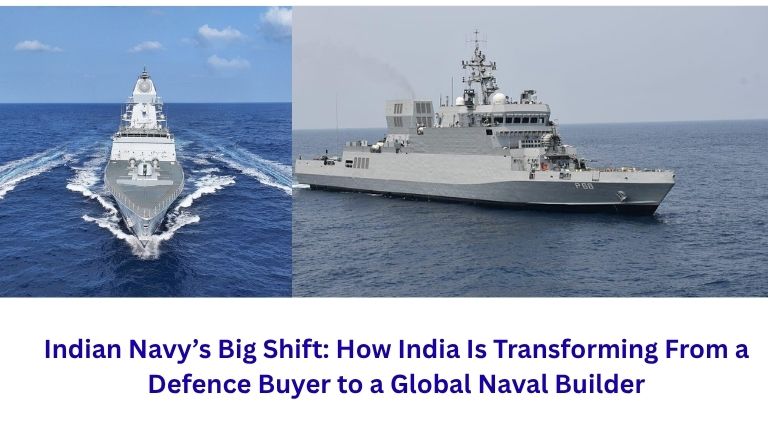
Indian Navy’s Big Shift: How India Is Transforming From a Defence Buyer to a Global Naval Builder
INS Dunagiri, INS Sanshodhak and INS Agray Commissioning Marks New Era for India’s Maritime Power
India’s naval strength is entering a new phase. With the commissioning of three indigenously designed and built naval platforms—INS Dunagiri, INS Sanshodhak and INS Agray—India has signalled a major transformation in its defence strategy: moving from being a military equipment buyer to becoming a global naval builder.
The induction of these advanced naval platforms reflects the growing success of India’s “Make in India” and Atmanirbhar Bharat initiatives while strengthening the country’s position in the Indian Ocean and Indo-Pacific region.
Indian Navy’s Journey: From Import Dependency to Indigenous Defence Manufacturing
For many decades, India depended heavily on foreign nations for warships, combat systems and advanced naval technologies. Today, the Indian Navy stands as one of India’s strongest examples of indigenous defence manufacturing.
The transformation has been supported by dedicated naval institutions responsible for ship design, weapons integration and advanced maritime technologies.
This shift has allowed India to gradually reduce dependence on imports and develop modern warships equipped with Indian-made systems.
Currently, the Indian Navy operates more than 130 warships and submarines, while nearly 50 additional vessels are under construction in Indian shipyards.
India aims to expand the fleet to around 155–160 warships by 2030, with domestic shipyards expected to lead most of this growth.
Why Maritime Power Matters More Than Ever
Modern global economies depend heavily on maritime routes.
Most global trade travels through sea lanes. Underwater communication cables carry massive volumes of digital traffic across continents. Access to deep-sea resources and future energy reserves is also becoming increasingly important.
As geopolitical competition intensifies, maritime capability has become a major indicator of national strength.
India’s naval expansion reflects this changing global reality.
INS Dunagiri: India’s Advanced Indigenous Stealth Frigate
Among the newly commissioned vessels, INS Dunagiri represents one of India’s most significant achievements in warship construction.
Built under Project 17A, INS Dunagiri belongs to the Nilgiri-class stealth frigates and showcases India’s progress in naval engineering.
The vessel features advanced combat capabilities including:
- Long-range missile systems
- Modern radar and surveillance systems
- Anti-submarine warfare capability
- Advanced platform management technology
With nearly 75 percent indigenous content, the project involved hundreds of Indian MSMEs and created thousands of employment opportunities.
The successful completion of INS Dunagiri highlights India’s improving shipbuilding speed and industrial maturity.
INS Sanshodhak Strengthens India’s Maritime Intelligence
INS Sanshodhak represents India’s growing capability in hydrographic and oceanographic operations.
The vessel is designed to:
- Conduct coastal and deep-water surveys
- Map navigation routes
- Support harbour development
- Improve maritime domain awareness
- Collect scientific and geophysical data
With indigenous content exceeding 80 percent, INS Sanshodhak demonstrates India’s ability to build specialised naval platforms using domestic expertise.
INS Agray Boosts India’s Anti-Submarine Warfare Capability
The third vessel commissioned, INS Agray, strengthens India’s coastal defence network.
Built as part of the Arnala-class Anti-Submarine Warfare Shallow Water Craft programme, the platform is designed for:
- Coastal anti-submarine operations
- Maritime surveillance
- Detection of underwater threats
- Mine warfare support
The vessel combines indigenous sonar systems, lightweight torpedoes and modern combat technology.
INS Agray further reinforces India’s strategy of developing advanced military assets inside the country.
How Indigenous Naval Growth Benefits India
India’s naval modernisation is delivering benefits beyond defence.
Key advantages include:
- Reduced dependence on foreign defence suppliers
- Growth of Indian manufacturing industries
- Job creation across MSMEs
- Stronger strategic presence in the Indo-Pacific
- Faster deployment of future naval platforms
This ecosystem is helping India build long-term technological self-reliance.
India’s Naval Future: Building the Fleet of Tomorrow
India’s naval expansion is far more than adding new ships.
Upcoming inductions and ongoing indigenous programmes indicate that India is creating a complete maritime manufacturing ecosystem capable of designing, building and sustaining advanced naval platforms.
The commissioning of INS Dunagiri, INS Sanshodhak and INS Agray marks an important milestone in that journey.
As India strengthens its maritime ambitions, the Indian Navy is emerging not just as a protector of the seas—but as a builder of India’s future defence capability.
Focus Keyword: Indian Navy Indigenous Warships
SEO Title: Indian Navy’s Transformation: How India Is Becoming a Global Naval Builder
Meta Description: Discover how INS Dunagiri, INS Sanshodhak and INS Agray highlight India’s shift from defence imports to indigenous naval shipbuilding under Make in India.